
The Switcheroo
Hi everyone,
Time for another bee update. And sorry in advance, I didn’t get a chance to get any good pictures.
I did an inspection on May 10. Hive A (the one that had to re-queen itself) was sparsely populated. There were no longer any queen cells, so this most likely means that one emerged and took out the competition. I did not see any eggs or larvae and I was about to give up on finding the queen, but there she was on the last frame. I went to get the camera and when I came back, I couldn’t find her again. Bee Mentor Steve (hereafter, “Steve”) said that she might not have been on a mating flight yet (the weather hadn’t been great).
On May 15, I found Hive A again very sparsely populated, and yet I still couldn’t spot the queen. But I did see young larvae (so about 3-4 days old) and some capped brood (they cap the larva cells when they start to pupate at day 9). This suggests that the queen was there and laying. Steve said, “don’t worry, give it time” (this will become a recurring theme).
As for Hive B (the very active one), on May 10, there was a lot of activity. Lots of honey, lots of young larvae and capped brood. I couldn’t spot the queen, even though we had marked her previously with a paint marker, but there’s good evidence that she was there. I noticed a lot of “bearding” (when a lot of bees congregate and hang from the underside of the entrance, making a “beard” formation). This could be due to the heat or due to overcrowding.
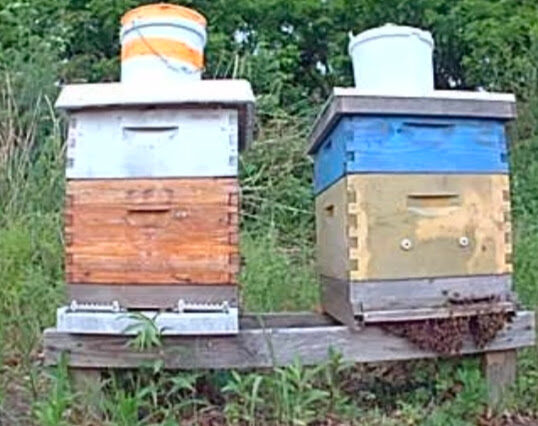
I asked Steve for advice and his answer was, of course, “don’t worry, give it time.” There is some new brood, so I am hopeful that the population starts to rebound in the next week or so as some of that brood emerges.
Steve: “You could also swap the hives?”
Me: “Swap the hives? You mean physically swap their positions? How will that help?”
Steve: “It’s a quick way to add some extra resources and population to the weaker hive.”
Apparently, if you pull the switcheroo during foraging hours, the foragers will come back to exactly the same spot they left from, seemingly unfazed by the fact that there is a different hive there.
I imagine the conversation goes something like this:
Forager 1: “Hey, does this look a little different to you? I remember there being more bees here.”
Forager 2: “Listen, sister, they don’t pay us enough to think. The work order says to drop off the pollen at the hive on the left. Let’s unload it and go on break.”
So I have switched positions, and also labeled the hives better. I also added another super (a box above the brood box) with 10 empty frames, so this should address overcrowding. Or it could be too late and they could be preparing to swarm. I did not have time to fully inspect and look for new queen cells (a clear sign that they are preparing to swarm and have a new queen lined up to take over).
The photo above is the “before.” The photo below is the “after.”
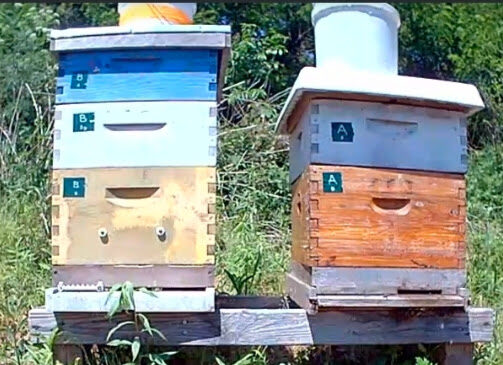
As you can see, they are now labeled, with Hive B on the left and Hive A on the right, and Hive B now has an additional “expansion pack.”
In the process of switching the hives, I accidentally knocked over Hive A (sorry, ladies!) but the bees seemed no worse for the wear (although I’m sure they didn’t like their house tumbling to the ground, upside down, like a huge earthquake). I hope I didn’t hurt the queen. When they fell, one of the boxes got out of square a bit. In true CERT spirit, I will repair this with duct tape to close up the gaps until I get a chance to swap out that box and move the frames into a new one.
That’s all for today.